Other Abstraction Layers
OpenMP, SYCL, RAJA, JAX, PyTorch, Taichi, Julia, LLVM, autodiff
Lars Pastewka
Learning objectives
After this lecture you can
- place Kokkos in the wider landscape of GPU programming models
- recognize the main alternatives: OpenMP target, RAJA, JAX, PyTorch, Taichi, Julia
- explain why LLVM is the common infrastructure behind most of them
- pick an appropriate abstraction layer for a given project
One source, many backends
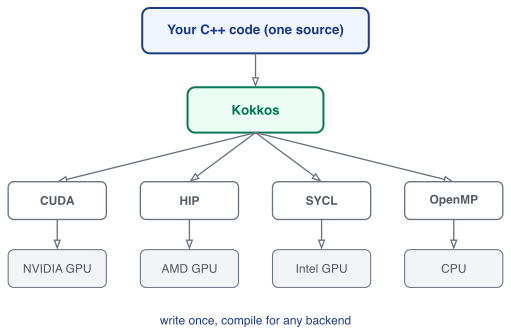
Kokkos does this – what else does?
The landscape
| Approach | Examples | Strength |
|---|---|---|
| Directives | OpenMP target | Incremental adoption |
| C++ libraries | Kokkos, RAJA, SYCL | Performance control |
| Python frameworks | JAX, PyTorch, Taichi | Productivity, autodiff |
| Language-level | Julia | High-level + fast |
OpenMP target offloading
- Add pragmas to existing code \(\rightarrow\) GPU execution
mapclauses control data movement- Supported by GCC 12+, Clang/LLVM,
nvc++,amdclang++ - Standardized but performance portability is harder than Kokkos
RAJA (LLNL)
- Same idea as Kokkos: execution policies as template parameters
- Focuses on loop execution only – uses separate libraries for memory (CHAI, Umpire)
- Widely used in LLNL production codes
JAX (Google)
- NumPy-compatible API + JIT compilation via XLA
jax.grad(f)\(\rightarrow\) automatic differentiationjax.vmap\(\rightarrow\) auto-vectorization,jax.pmap\(\rightarrow\) multi-GPU- Functional programming model (no side effects)
PyTorch (Meta)
- Dominant in deep learning, increasingly used in scientific computing
- Eager execution by default +
torch.compilefor JIT optimization - Autograd engine for reverse-mode automatic differentiation
- CUDA + ROCm backends
Taichi
- Python DSL for spatial computing: particles, grids, meshes
@ti.kernelcompiles via LLVM \(\rightarrow\) CUDA / Vulkan / Metal- Built-in sparse data structures and automatic differentiation
Julia
- A language designed for numerical computing, compiled via LLVM
KernelAbstractions.jl= Kokkos-like portability (CUDA, ROCm, CPU)Enzyme.jl= compiler-level AD through GPU kernels- Performance comparable to C/C++ with Python-like syntax
The role of LLVM
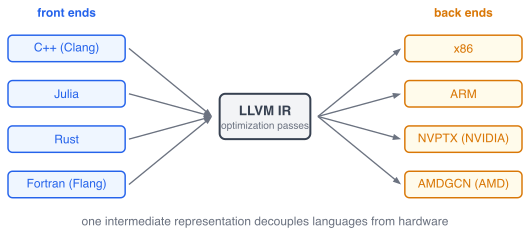
- Common infrastructure behind Clang, Julia, Taichi, Enzyme
- Same back ends generate GPU code for many front-end languages
- AMD ROCm is entirely LLVM-based; NVIDIA moving toward LLVM too
Automatic differentiation
Forward mode: propagate derivatives alongside computation (\(n\) inputs \(\rightarrow\) \(n\) passes)
Reverse mode: record computation graph, traverse backward (\(m\) outputs \(\rightarrow\) \(m\) passes)
- ML training: reverse mode = backpropagation (millions of params, one scalar loss)
- Differentiable physics: differentiate through entire simulations
- Enzyme: AD at the LLVM IR level \(\rightarrow\) works for any LLVM language, including GPU kernels
Comparison summary
| Language | AD | GPU backends | Compilation | |
|---|---|---|---|---|
| Kokkos | C++ | No | CUDA, HIP, SYCL | AOT |
| OpenMP | C/C++/Fortran | No | CUDA, HIP | AOT |
| RAJA | C++ | No | CUDA, HIP | AOT |
| JAX | Python | Yes | CUDA, ROCm, TPU | JIT (XLA) |
| PyTorch | Python | Yes | CUDA, ROCm | Eager+JIT |
| Taichi | Python | Yes | CUDA, Vulkan | JIT (LLVM) |
| Julia | Julia | Yes | CUDA, ROCm | JIT (LLVM) |
Which should you pick?
- C++ codebase + portability \(\rightarrow\) Kokkos / RAJA
- Python + autodiff \(\rightarrow\) JAX / PyTorch
- Pragmas on legacy code \(\rightarrow\) OpenMP target
- Vendor-locked maximum performance \(\rightarrow\) CUDA / HIP
Summary
- Many roads to the GPU: directives, C++ template libraries, Python JIT frameworks, whole languages
- Nearly all of them funnel through LLVM IR to reach multiple hardware back ends
- Python frameworks add automatic differentiation – C++ layers generally do not
- The right choice depends on your codebase, your need for autodiff, and how portable you must be
Reading
HPC: Parallelization on GPUs and Accelerators