The HPC landscape
From room-filling machines to accelerated exascale systems
Machines have always filled rooms
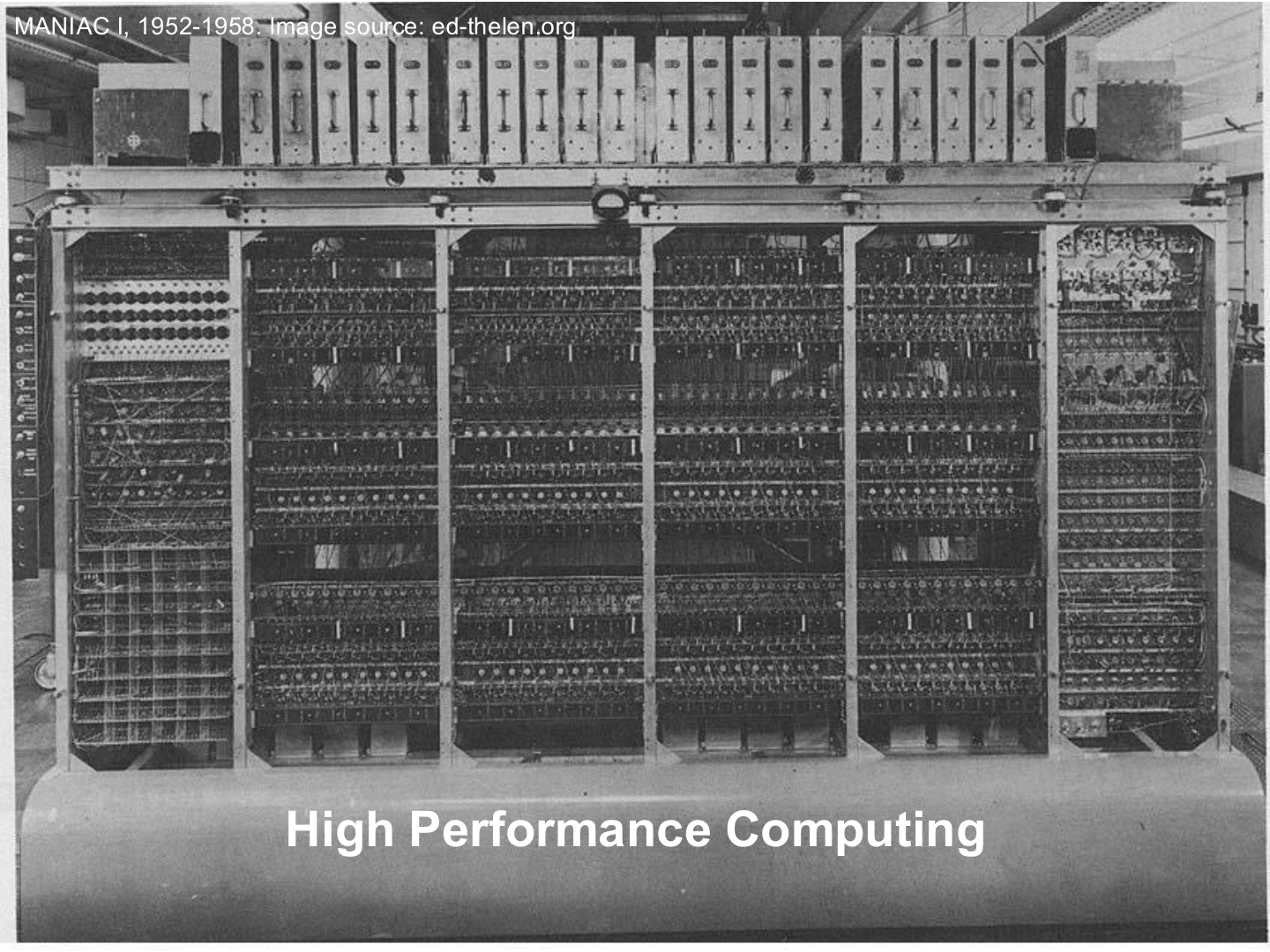
MANIAC I (Mathematical Analyzer, Numerical Integrator, And Computer), 1952–1958. Image source: ed-thelen.org
- MANIAC I and UNIVAC: the high-performance computers of the 1950s
- High-performance computing is not new – only the hardware inside the room changes
HPC 2020–2025: two flagship philosophies
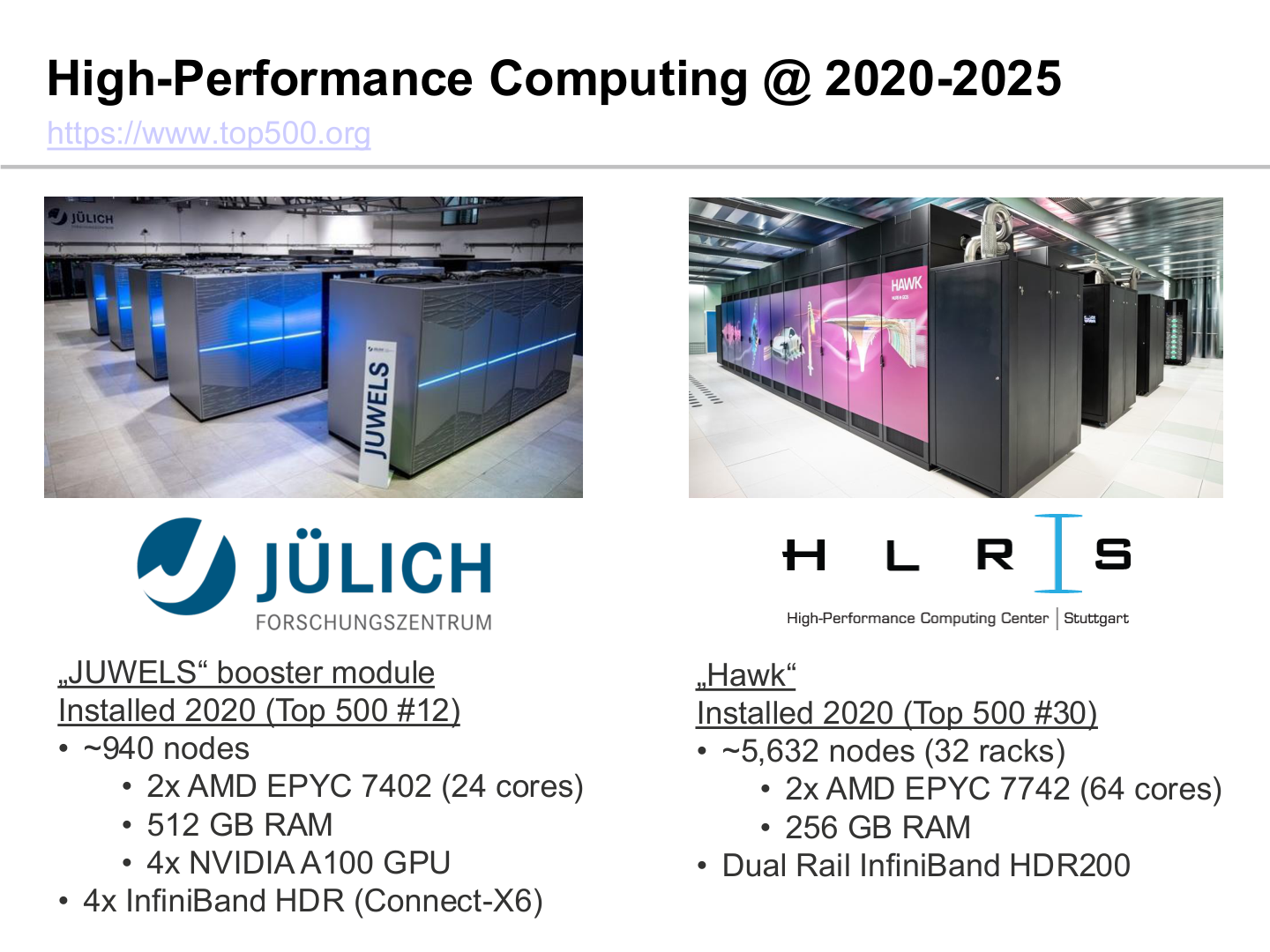
JUWELS booster (Jülich) and Hawk (HLRS Stuttgart). Source: https://www.top500.org
- JUWELS booster (Jülich, 2020, Top500 #12): ~940 nodes, 2× AMD EPYC 7402 (24 cores), 512 GB RAM, 4× NVIDIA A100, 4× InfiniBand HDR
- Hawk (HLRS Stuttgart, 2020, #30): ~5632 nodes, 2× AMD EPYC 7742 (64 cores), 256 GB RAM, CPU-only
- Same era, two philosophies: GPU-accelerated vs CPU-only
HPC 2025–2030: accelerators win
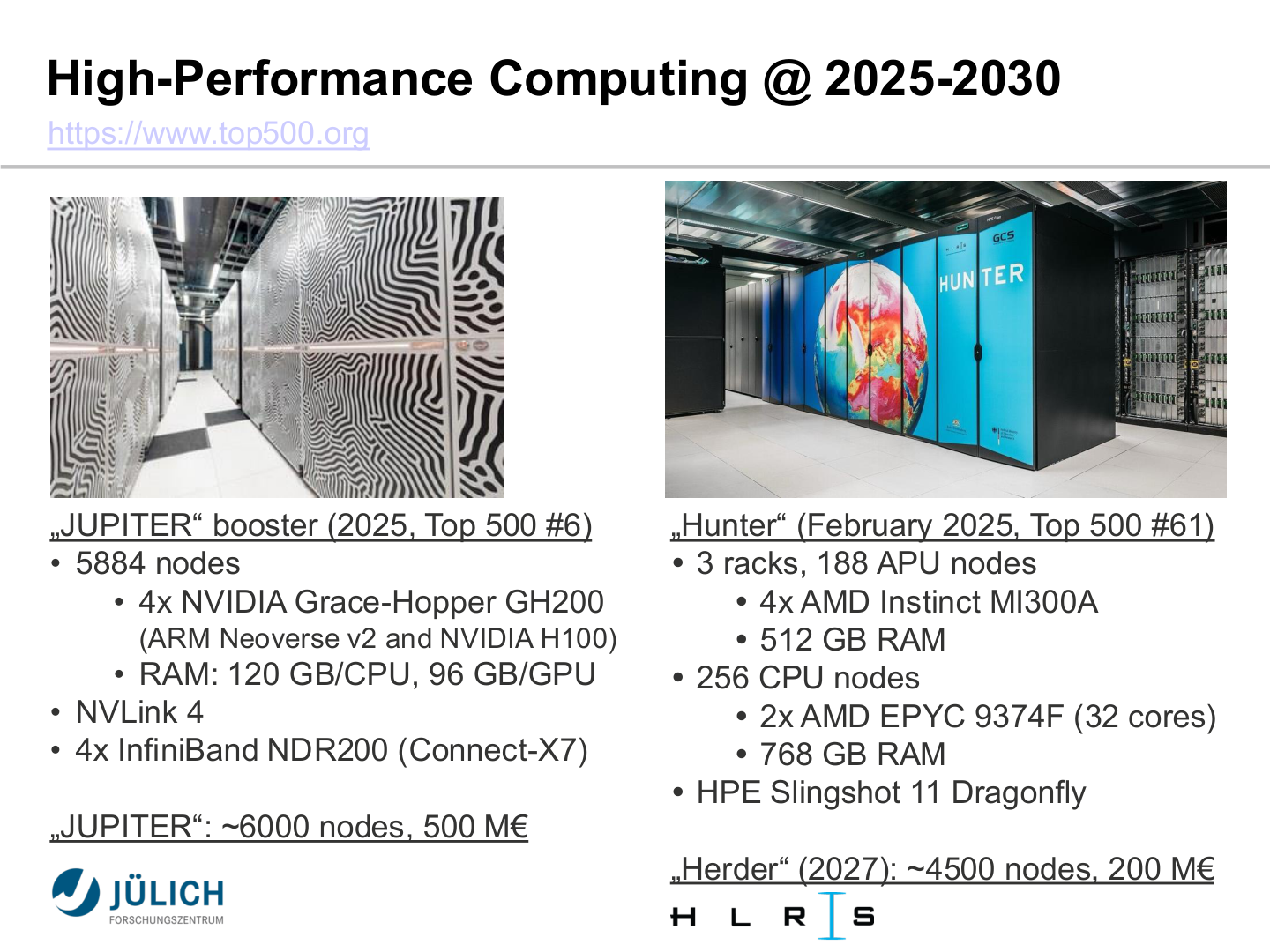
JUPITER booster (Jülich) and Hunter (HLRS Stuttgart). Source: https://www.top500.org
- JUPITER booster (2025, #6): 5884 nodes, each 4× NVIDIA Grace-Hopper GH200, NVLink 4, 4× InfiniBand NDR200 – ~500 M€
- Hunter (HLRS, 2025, #61): 188 APU nodes with 4× AMD Instinct MI300A + 256 CPU nodes, HPE Slingshot
- Herder (2027): ~4500 nodes, ~200 M€
Where is Tier I in Germany?
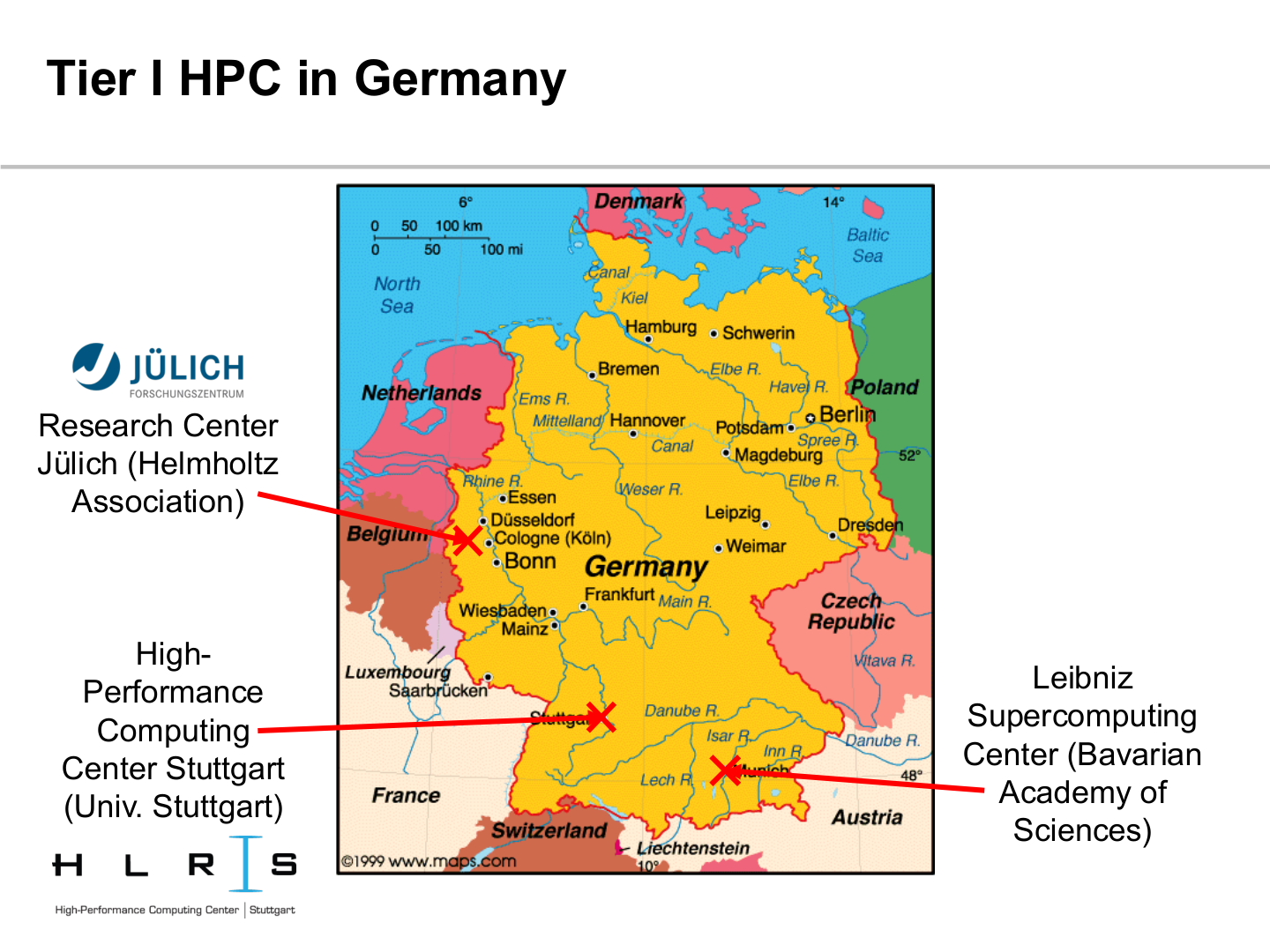
The three German Tier-I (national) centers: Jülich, HLRS Stuttgart, LRZ Munich. Background map © 1999 maps.com
- Jülich Supercomputing Centre (JUWELS, JUPITER)
- HLRS Stuttgart (Hawk, Hunter, Herder)
- LRZ Munich (SuperMUC)
The tier pyramid: where will you compute?
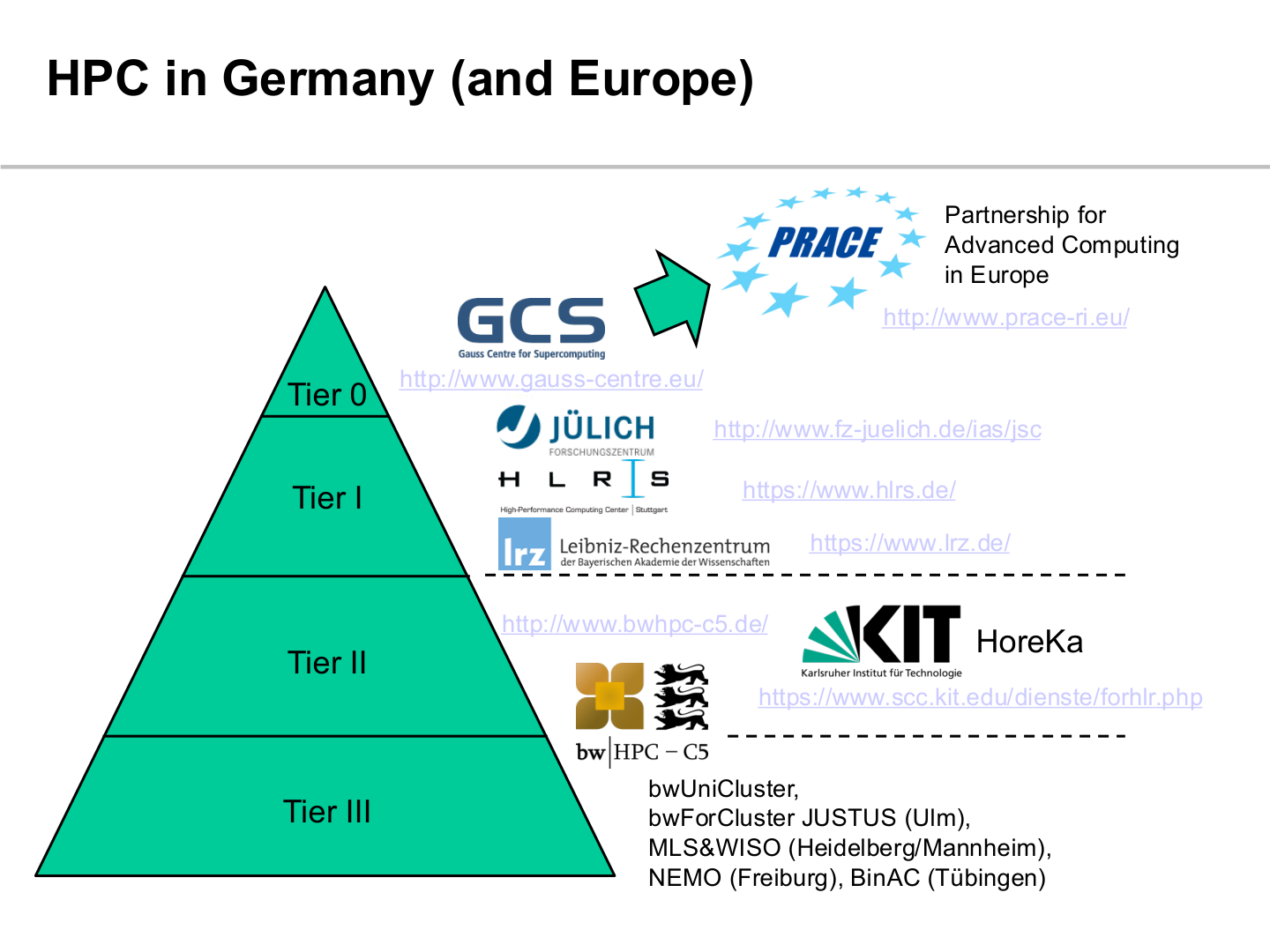
European/German HPC tier structure. Center and project logos: GCS, Jülich, HLRS, LRZ, KIT, bwHPC-C5
- Tier 0: European machines (PRACE)
- Tier I: national centers (GCS: Jülich, HLRS, LRZ)
- Tier II: regional/topical systems (bwHPC, HoreKa at KIT)
- Tier III: local clusters – bwUniCluster, NEMO (Freiburg) ← this is where you will compute
Classic homogeneous HPC: IBM Blue Gene/Q
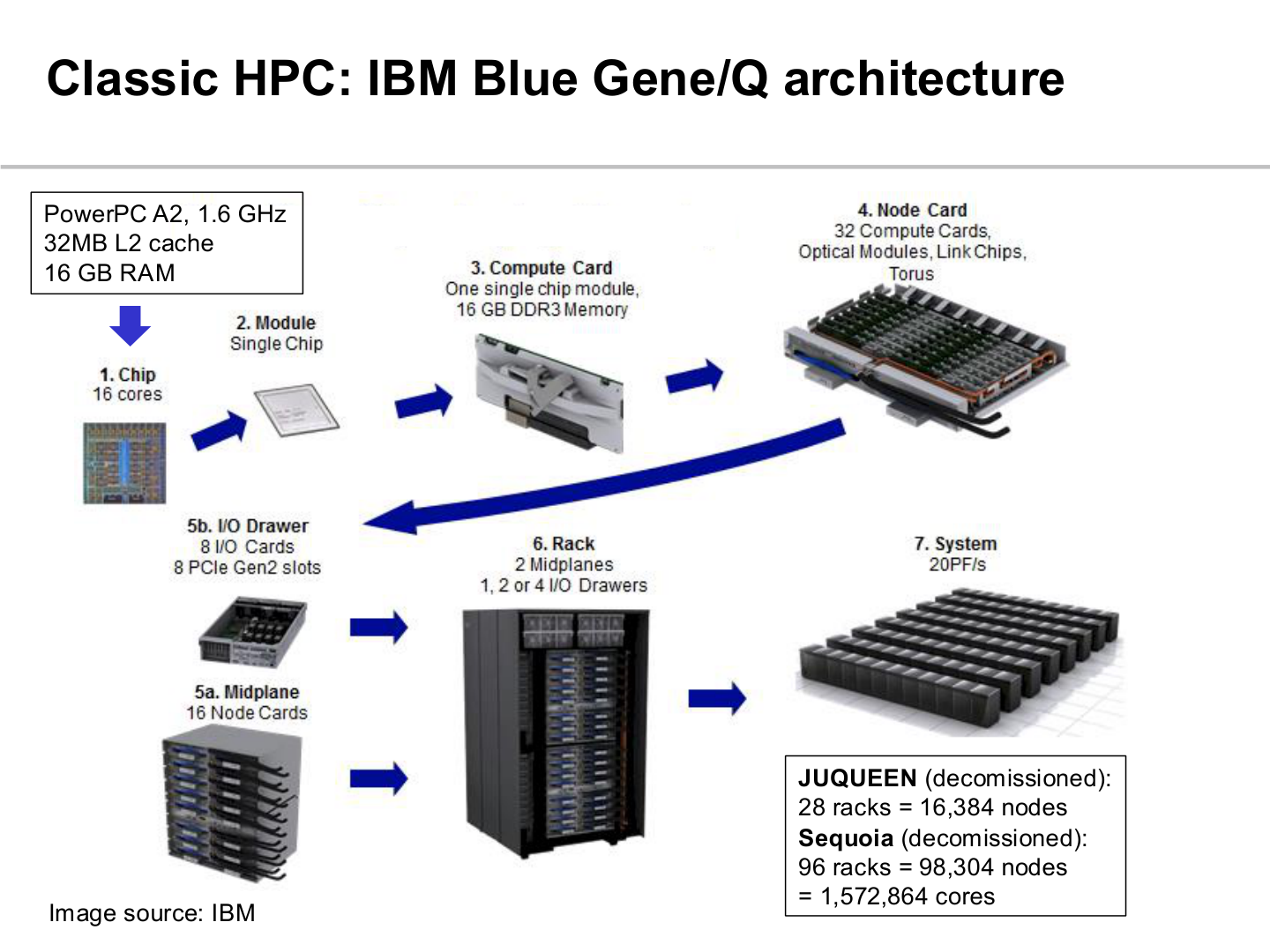
Blue Gene/Q build-up: chip → module → compute card → node card → midplane → rack → system (20 PF/s). Image source: IBM
- Machines are built hierarchically: many identical units, replicated at every level
- JUQUEEN (Jülich): 28 racks, 458,752 cores
- Sequoia (LLNL): 96 racks, 1,572,864 cores
The accelerated present: NVIDIA Grace-Hopper
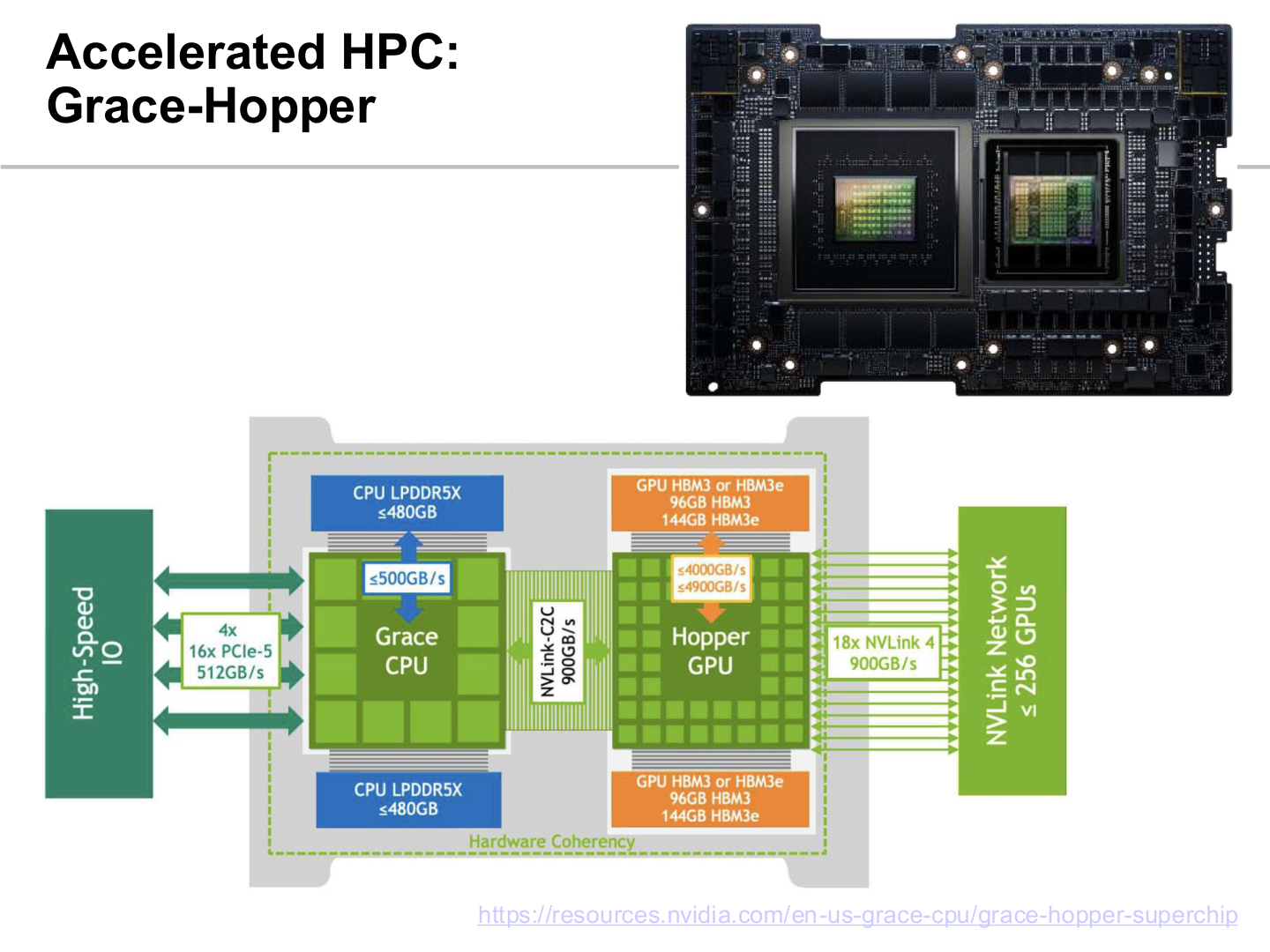
GH200 Grace-Hopper Superchip. Source: https://resources.nvidia.com/en-us-grace-cpu/grace-hopper-superchip
- Grace CPU: LPDDR5X, up to 480 GB, ~500 GB/s
- Hopper GPU: HBM3, 96–144 GB, ~4000–4900 GB/s
- NVLink-C2C between them: 900 GB/s; NVLink 4 to other GPUs; PCIe-5 for IO
The vendor landscape
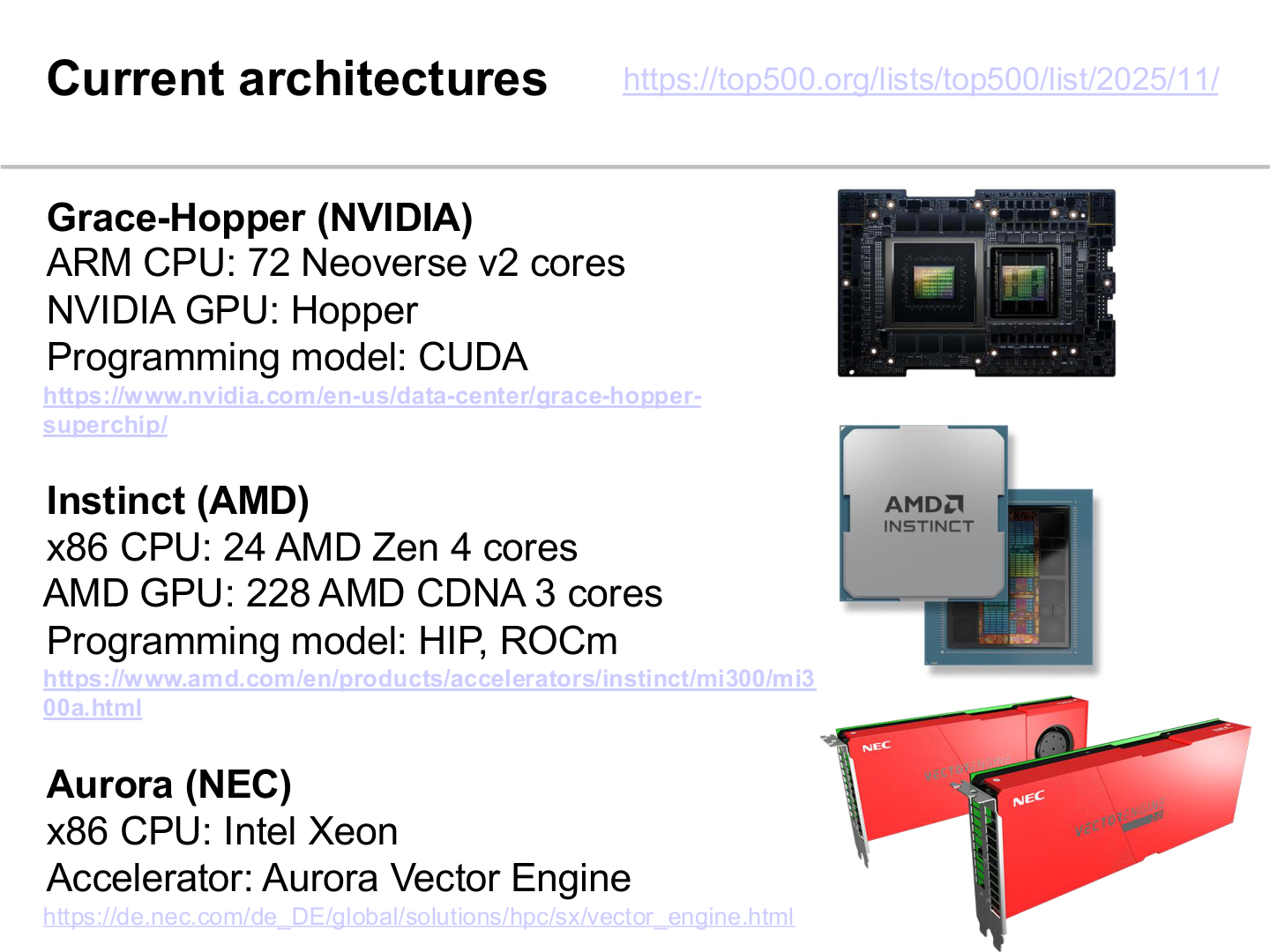
Current accelerator architectures: NVIDIA Grace-Hopper, AMD Instinct, NEC Aurora. Vendor sources on slide
- NVIDIA Grace-Hopper → programmed with CUDA
- AMD Instinct MI300A → programmed with HIP/ROCm
- NEC Aurora vector engines → yet another model
- Many vendors, many programming models → we need hardware abstraction (next lecture: Kokkos)