GPU architecture
GPU execution model, memory hierarchy, occupancy
Learning objectives
After this lecture you can
- sketch the topology of a GPU node and rank its interconnect bandwidths
- explain the SIMT thread hierarchy (grid, block, warp) and how it maps to SMs
- navigate the GPU memory hierarchy and quote its key latencies
- explain how GPUs hide memory latency and compute occupancy limits
A node with accelerators
![]()
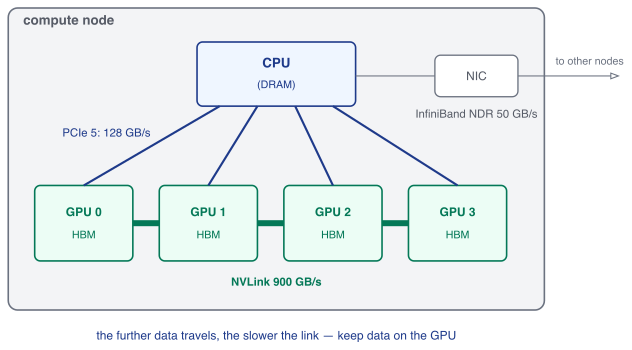
PCIe is slower than you think – sometimes slower than the network.
CPU vs. GPU: design philosophy
![]()
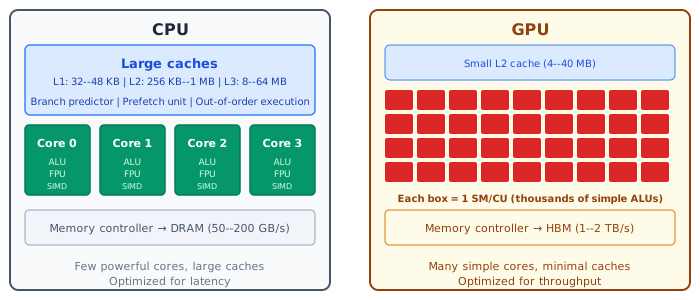
- CPU: few complex cores, large automatic caches, latency-optimized
- GPU: thousands of simple cores, small caches, throughput-optimized
GPU code must expose tens of thousands of independent threads.
SIMT execution model
- GPU threads execute the same function (kernel) on different data
- Threads are grouped into thread blocks (or workgroups)
- Within a block, threads execute in warps (NVIDIA, 32 threads) or wavefronts (AMD, 64 threads)
- All threads in a warp execute the same instruction at the same time
Thread hierarchy
![]()
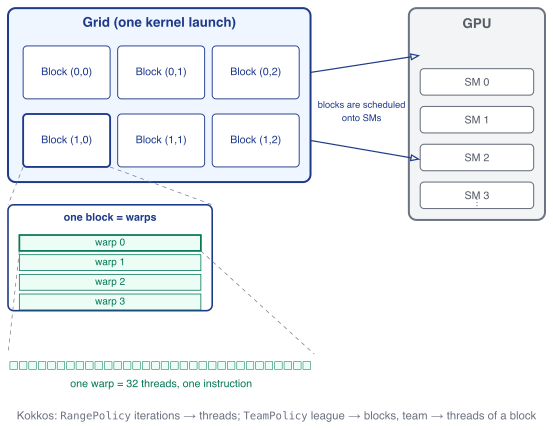
- Grid = all blocks of one kernel launch (independent, any order)
- Block = threads that cooperate via shared memory + barriers; scheduled onto one SM
- Warp = smallest scheduling unit (lockstep execution)
Streaming multiprocessors / compute units
- SM (NVIDIA) / CU (AMD): the physical execution unit
- Contains: arithmetic units, register file, shared memory, warp schedulers
- A GPU has 50–150 SMs/CUs
- Hardware distributes blocks across SMs; once assigned, a block runs to completion
Warp divergence
![]()
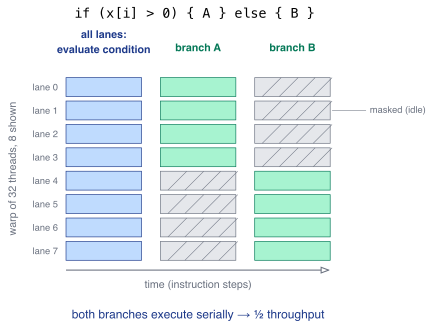
if/else inside a warp: both branches execute, inactive lanes are masked- Worst case: throughput drops to the fraction of active lanes
- Mitigation: branch on block index, not thread index – entire warps go one way
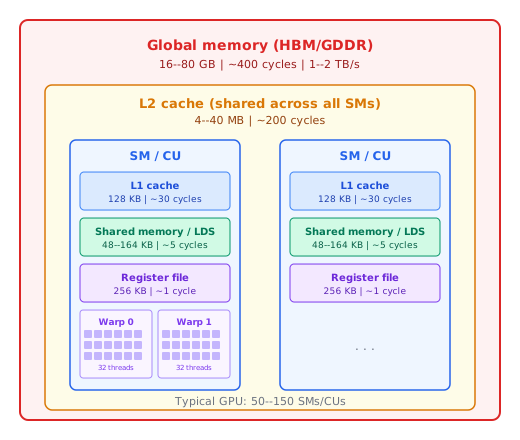
GPU memory hierarchy
![]()
Three numbers worth remembering:
- registers ~1 cycle, shared/L1 ~30 cycles, HBM ~400 cycles
Registers and shared memory
Registers – per-thread, fastest, finite budget shared across all active threads
- More registers per thread → fewer active threads → less latency hiding
- Overflow: register spilling to slow global memory
Shared memory – per-block, programmer-managed (48–164 KB per SM)
- Enables tiling and inter-thread communication; bank conflicts serialize access
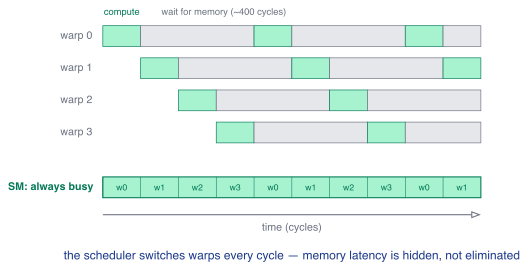
Latency hiding: the core trick
![]()
- A warp stalls on a memory access → the scheduler instantly switches to another warp
- Enough resident warps → the memory latency disappears behind useful work
Occupancy
\[\text{Occupancy} = \frac{\text{active warps per SM}}{\text{max warps per SM}}\]
Limited by: registers/thread, shared memory/block, block size.
Aim for ≥50% – but 50% with good data reuse can beat 100% that hammers global memory.
Profile with ncu (NVIDIA) or rocprof (AMD).
Worked example: register-limited kernel
Kernel uses 48 registers/thread; SM has 65,536 registers, max 2,048 threads (64 warps).
- Register file fits \(\lfloor 65{,}536 / 48 \rfloor = 1{,}365\) threads
- Warps of 32: \(\lfloor 1{,}365 / 32 \rfloor = 42\) active warps = 1,344 threads
- Occupancy: \(42/64 \approx 66\%\) – register-limited, regardless of block size
Reducing to 32 registers/thread allows all 2,048 threads (100%).
Vendor nomenclature
| Scheduling unit |
Warp (32) |
Wavefront (64) |
Sub-group |
| Thread group |
Thread block |
Workgroup |
Work-group |
| Processing unit |
SM |
CU |
EU |
| On-chip memory |
Shared memory |
LDS |
SLM |
| Compiler |
nvcc |
hipcc |
icpx |
What this means for your LBM code
- One thread per lattice site: a \(1000^2\) grid = \(10^6\) threads – exactly what the GPU wants
- Kokkos
parallel_for + RangePolicy → kernel launch; the runtime picks block sizes
- Collision is uniform work → no warp divergence; boundaries need care
- Performance hinges on how warps access memory – coalescing depends on data layout → next lecture
Summary
- A node couples CPU and GPUs via PCIe; GPU–GPU (NVLink) and even the network can be faster
- SIMT hierarchy: grid → block → warp; warps execute in lockstep, divergence costs throughput
- Memory hierarchy: registers ~1 cycle, shared/L1 ~30, HBM ~400
- GPUs hide latency by warp switching, not caching – occupancy measures how much hiding is possible
- Registers and shared memory per SM limit occupancy