Runtime-sized dimensions must come first. Use compile-time extents when sizes are known to help the compiler.
Memory spaces
Kokkos space
Maps to
HostSpace
CPU RAM
CudaSpace / HIPSpace
GPU global memory
CudaUVMSpace / HIPManagedSpace
Unified memory
ScratchMemorySpace
Shared memory / LDS
Every view has a memory space set at compile time:
Kokkos::View<double*, Kokkos::CudaSpace> d_data("device", N);// GPUKokkos::View<double*, Kokkos::HostSpace> h_data("host", N);// CPU
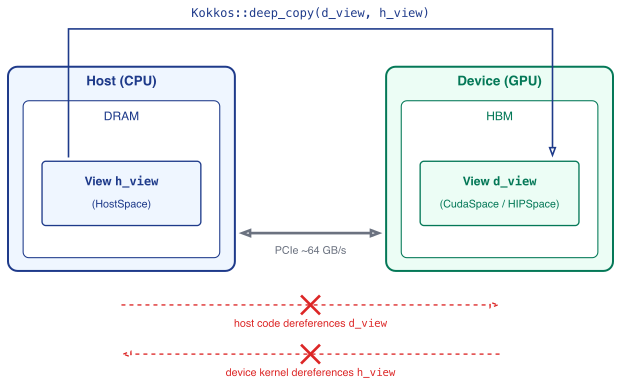
Figure 1: Host and device are separate address spaces; the only legal way to move data is an explicit deep_copy. The red crosses mark the two illegal access patterns we are about to attempt.
Anatomy of a kernel launch
When you call Kokkos::parallel_for(...):
You declare views (allocations on the right memory space)
You instantiate a functor / lambda that captures the views
parallel_for copies the functor (the closure, ~tens of bytes) to the device, runs the kernel, and releases the device-side functor copy
The view data is not copied – views are like pointers; the lambda captures them by value (the pointer copies, the data does not).
Failed attempt 1: data on the device, populated on the host
View<double*, CudaSpace> array("array", size);for(int i =0; i < size;++i) array(i)= read_from_file();// ← segfault: GPU memory from CPUdouble sum =0;Kokkos::parallel_reduce("Label", RangePolicy<Cuda>(0, size), KOKKOS_LAMBDA(constint i,double& s){ s += array(i);}, sum);
Wrong: the host for loop touches GPU memory directly – the first red X in Figure 1 (host code dereferences d_view).
Failed attempt 2: data on the host, kernel on the device
View<double*, HostSpace> array("array", size);for(int i =0; i < size;++i) array(i)= read_from_file();// ✓ host populates host memorydouble sum =0;Kokkos::parallel_reduce("Label", RangePolicy<Cuda>(0, size), KOKKOS_LAMBDA(constint i,double& s){ s += array(i);},// ← illegal sum);
Wrong: the CUDA kernel cannot dereference a host pointer – the second red X in Figure 1 (device kernel dereferences h_view).
We need a way to keep both copies and move data between them on demand.
Mirroring pattern
The canonical Kokkos recipe for I/O:
// 1. Allocate the device viewusingview_t= View<double*, Kokkos::CudaSpace>;view_t view("data", size);// 2. Create a host-side mirrorauto host_view = Kokkos::create_mirror_view(view);// 3. Populate on the host (from file, etc.)for(int i =0; i < size;++i) host_view(i)= read_from_file();// 4. Deep copy host → deviceKokkos::deep_copy(view, host_view);// 5. Run the kernel on the deviceKokkos::parallel_reduce("L", RangePolicy<Cuda>(0, size), KOKKOS_LAMBDA(constint i,double& s){ s += view(i);}, sum);// 6. Deep copy device → host (if needed for output)Kokkos::deep_copy(host_view, view);
create_mirror vs create_mirror_view
create_mirror – always allocates a new array on the host
create_mirror_view – allocates only if needed: if the view already lives on the host, the mirror simply references the same data
The _view form is the one you usually want – it makes the same code do nothing extra on a CPU build and the right thing on a GPU build.
Reminder: Kokkos never performs a hidden deep copy.
Execution & Memory
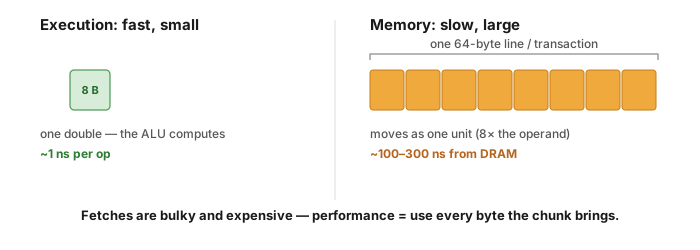
A processor juggles two very different “operands”:
Execution — fast, small: the ALU/FPU computes on a register word, 8 bytes (one double), in ~1 ns.
Memory — slow, large: caches and DRAM only move data in fixed cache lines / transactions, 64 B (CPU) or 32–128 B (GPU), at ~100–300 ns.
CPU threads vs GPU threads
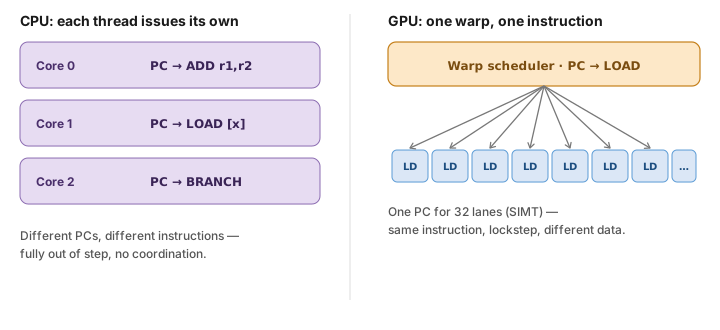
The architectures differ in whether a thread individually issues and executes its instructions.
CPU thread: independent
GPU thread (lane): 32 lanes form a warp — 32 lanes run the same instruction on different data.
CPU caching: cache lines
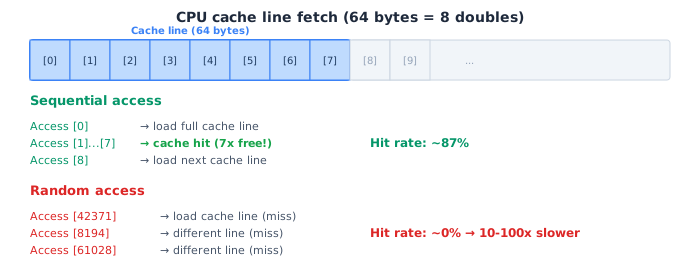
CPUs fetch memory in 64-byte cache lines. Access data[0] → data[0]–data[7] (doubles) loaded into L1.
Sequential: ~87% hit rate, effective latency ≈ L1 (few ns)
Random: ~0% hit rate, every access pays full DRAM latency (100–300 ns)
⇒ 10–100× performance difference from access pattern alone.
GPU coalescing
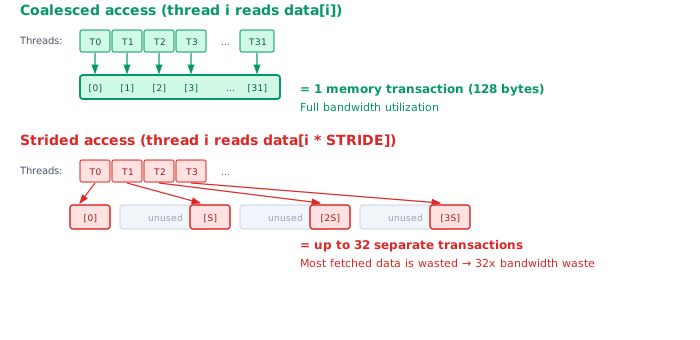
32 threads in a warp issue loads simultaneously.
Coalesced (thread \(i\) reads data[i]):
→ 32 addresses merge into one 128-byte transaction. Full bandwidth.
→ Up to 32 separate transactions. 32× bandwidth waste.
Rule: ensure unit-stride access within a warp.
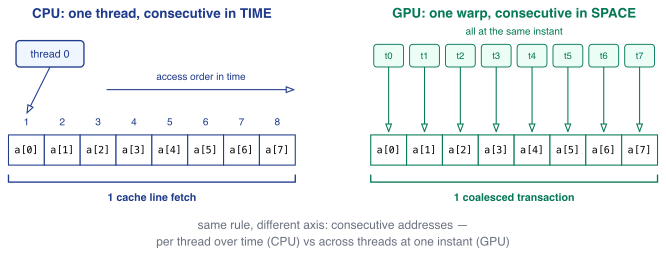
Caching vs. coalescing – the symmetry
Figure 2: CPU: thread \(t\)’s next access at \(i+1\) → cached. GPU: thread \(t+1\)’s current access at \(i+1\) → coalesced.
Both reward unit-stride memory access – but along different axes of your data.
⇒ You usually need different memory layouts on CPU and GPU. Pure portable code (OpenMP, OpenACC) can’t help with this. Kokkos can.
Shape is just interpretation
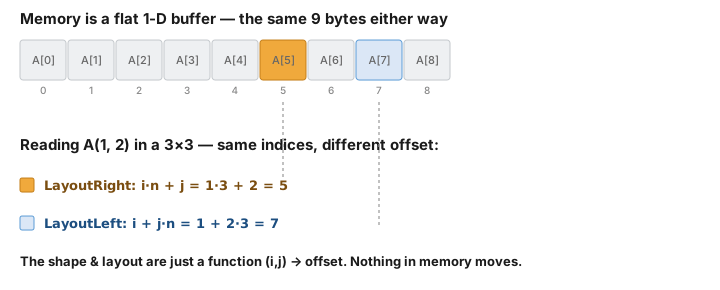
A View’s data is a flat 1-D buffer. The shape (n×n) and layout only define a map from indices to a linear offset — they move no bytes.
LayoutRight: offset = \(i\cdot n + j\)
LayoutLeft : offset = \(i + j\cdot n\)
A(1,2) is offset 5 under Right, 7 under Left.
Layouts and memory spaces
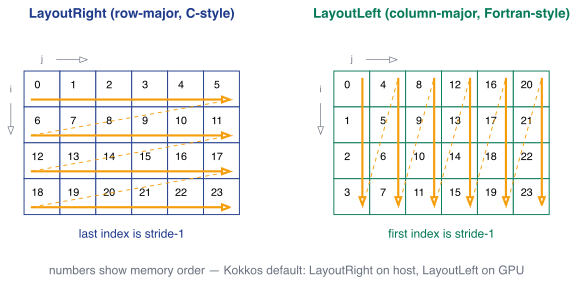
View<T**, Layout, Space> – the layout is a template parameter.
Figure 3: LayoutRight: the rightmost index is stride-1. LayoutLeft: the leftmost index is stride-1.
Layout
Stride-1 axis
Default for
LayoutRight
rightmost (row-major, C-style)
HostSpace
LayoutLeft
leftmost (column-major, Fortran-style)
CudaSpace / HIPSpace
If you don’t specify a layout, Kokkos picks the right one for the memory space – that is the whole point of letting Kokkos choose.
Index mapping rule of thumb
Kokkos maps work indices differently per execution space:
CPU (OpenMP, Threads): contiguous chunks per thread → caching
GPU (Cuda, HIP): strided across threads in a warp → coalescing
Rule of thumb: write your views so the iteration index is the first index of every view access. Combined with the default layouts, this gives cached access on CPU and coalesced access on GPU – the same source code.
view(workIndex,...,...)=...;// ✓ portableview(..., workIndex,...)=...;// potentially slow on one architecture
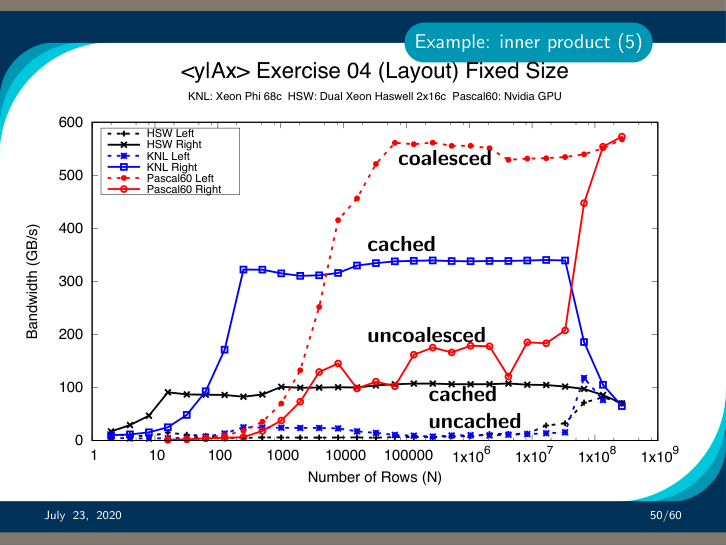
Layout matters: empirical evidence
Figure 4: Bandwidth (GB/s) vs. number of rows N for the inner-product kernel ⟨y|Ax⟩, run on Haswell (HSW), Knights Landing (KNL) and Pascal P100. LayoutLeft is fast on the GPU; LayoutRight is fast on the CPUs. From the Sandia Kokkos tutorial (SAND2020-7475).